De-Islamizing Turkey: When Islam Becomes a Problem Because It Succeeds

Would you like to support our work : https://ko-fi.com/parolemusulmane

1. A revealing document, not an innocent one
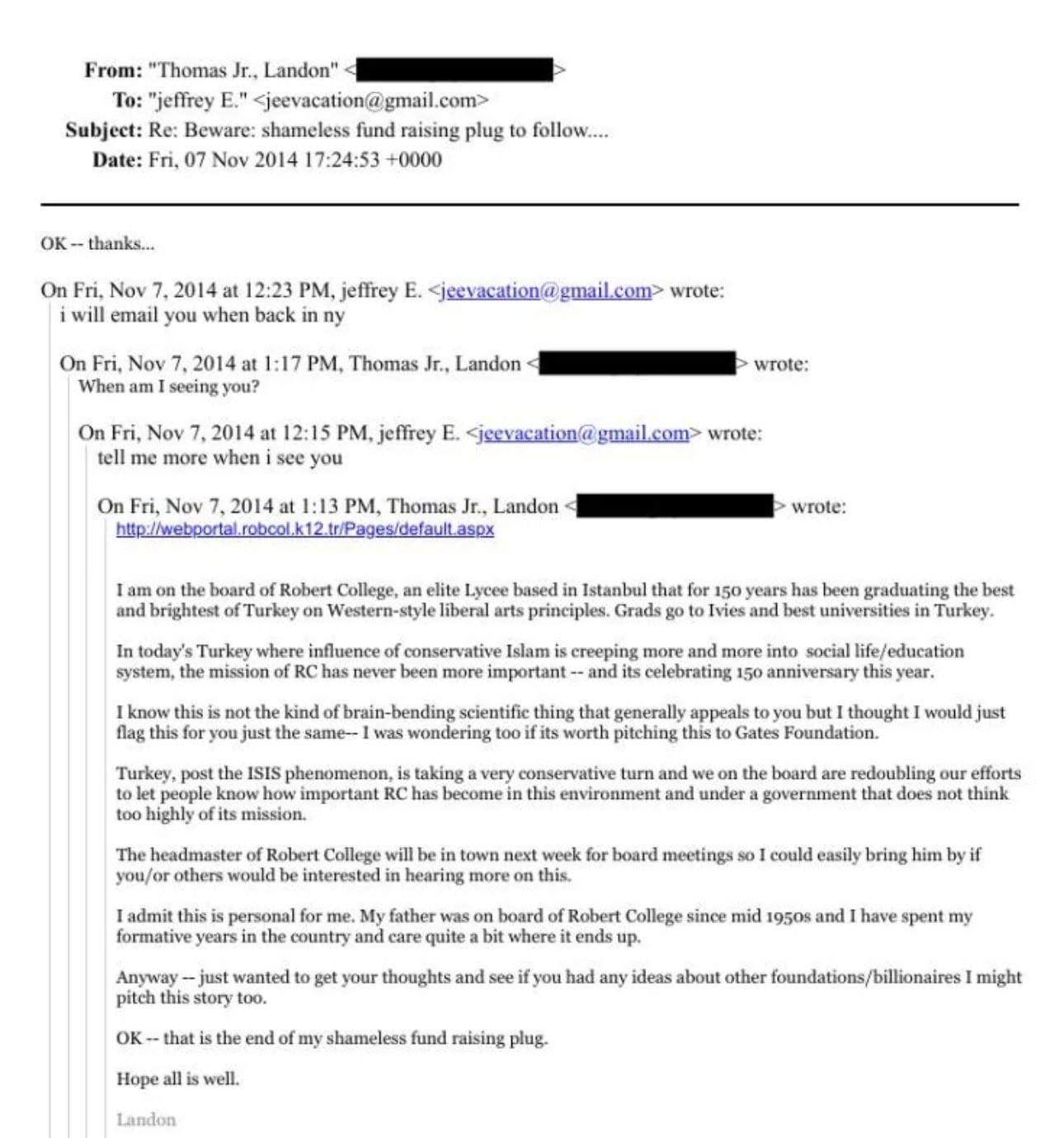
Among the documents now declassified and archived by the FBI, one finds a private email exchange from 2014.
This is not an official FBI statement, but a genuine private correspondence, preserved within intelligence and monitoring files, which sheds light on the mindset and intentions of certain Western influence networks.
The author of the email presents himself as a board member of Robert College, an elite high school in Istanbul historically aligned with Western liberal education.
His objective is explicit: to raise funds, including from major Western philanthropic structures such as the Bill & Melinda Gates Foundation, in order to strengthen what he views as an ideological bulwark against Turkey’s social evolution.
2. “Conservative Islam”: an ideological euphemism
At the heart of this email lies a recurring concern: the rise of what the author calls “conservative Islam” in Turkey.
This expression, however, is neither neutral nor innocent.
👉 “Conservative Islam” is not a deviation.
In reality, it largely refers to Islam itself:
- a religion with norms,
- a moral framework,
- a coherent worldview,
- and a continuous historical tradition.
Labeling Islam as “conservative” functions as a way to delegitimize it in advance, as if it must be:
- reformed,
- diluted,
- or rewritten in order to be acceptable.
It is a coded way of saying:
“Islam as it is actually practiced by Muslims is a problem.”
3. An Islamophobic obsession disguised as educational concern
What this document reveals is striking:
Islam is not criticized for concrete acts of violence or instability, but for what it is and for the space it occupies.
There is no reference to chaos, terrorism, or social collapse.
What seems to disturb the author is:
- that Turkish society increasingly embraces its Muslim identity,
- that this identity does not lead to failure,
- and that it coexists with ambition, competence, and national confidence.
Behind the polite language of education and philanthropy lies an ideological anxiety:
What if a Muslim country could succeed without dissolving itself into the Western model?
4. Success while remaining Muslim: the real scandal
What emerges from this discourse is a poorly concealed resentment:
- resentment at seeing Muslim societies organize themselves,
- resentment at witnessing Muslim-majority states assert cultural sovereignty,
- resentment that Islam does not disappear when faced with modernity.
For decades, a narrative has been imposed:
To succeed, a Muslim country must Westernize.
Turkey — like other Muslim societies — challenges this assumption.
And that challenge is perceived not as diversity, but as defiance.
5. Condescension rooted in a sense of superiority
The tone of the email reflects a persistent civilizational condescension:
- the West casts itself as the guardian of progress,
- Islam is framed as a backward force to be managed,
- education becomes a tool for ideological correction.
This is not a dialogue between cultures.
It is a strategy of soft re-engineering, where:
- acceptable local elites are those who think in Western terms,
- and those who do not are viewed as inherently problematic.
This posture is not new. It extends a long post-colonial reflex, simply repackaged in humanitarian and liberal language.
6. De-Islamizing Turkey… and beyond
Turkey is not an isolated case.
It is a testing ground.
What this document suggests is a broader ambition:
- to de-Islamize Muslim societies through their elites,
- to influence future generations via selective educational institutions,
- to neutralize Islam not through force, but through ideological normalization.
When this strategy fails, the language hardens:
- “conservative drift,”
- “threat to values,”
- “democratic backsliding.”
Yet the core issue remains unchanged:
👉 An Islam that refuses to submit ideologically is deemed illegitimate.
7. Conclusion: Islam does not need permission to exist
This document does not prove a global conspiracy.
It reveals something far more common — and therefore more troubling:
- a structural hostility toward lived Islam,
- an inability to accept Muslim success on its own terms,
- a worldview in which Western norms still claim universal authority.
Islam does not need to be “corrected” to be legitimate.
It does not need to be diluted to be modern.
And above all, it does not need to apologize for existing — or for succeeding.